
A good image can convey a story before even the first sentence is read. A blog post will be livelier, a lowly idea gets a boost to popular lore and maybe even a business describes what it is about. But making original imagery has traditionally meant photography gear and design skills, or professional software access.
AI image generation is changing that process.
Now it is possible to articulate an idea in plain language, and then feed that very description into artificial intelligence for the software to create a visual. This technology enabled imaging creation for masses who have little to no experience on conventional design tools.
The true power of AI images is not the ability to generate an image quickly, though. It is the liberty to test ideas that would otherwise linger in the mind of a free thinker.
From an Idea to a Visual
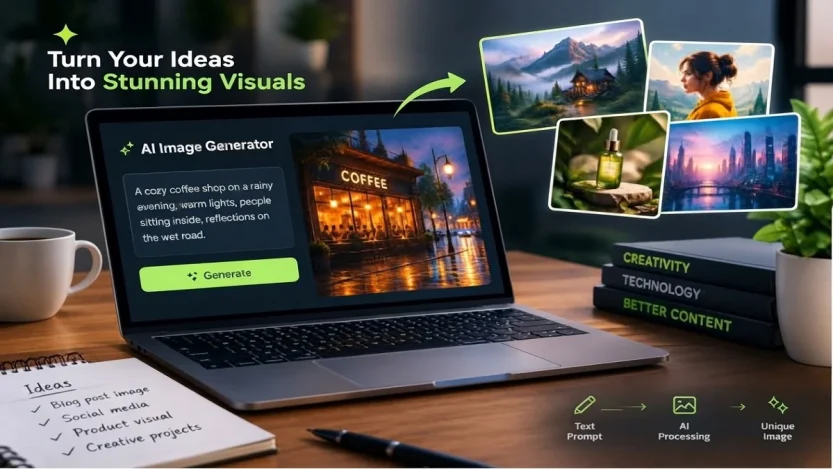
Think of someone trying to imagine a small cafe on a rainy night. They picture warm lights shining behind the windows, reflections dancing on the wet road, perhaps a couple at secluded tables laughing and conversing in hushed voices.
To create this specific scene traditionally would require scouting a location, setting up lights, photographing or illustrating.
Using an AI image generator, the same person can describe the scene and receive a visual representation of the concept.
That first result may not look exactly like what they hoped. This is not likely to be a problem. They can modify the description, alter the vibe, insert of detail or apply a different style.
This makes the creative process more flexible. Instead of needing to know exactly how to build an image from the beginning, users can discover ideas by experimenting.
Why AI Image Generation Has Become Popular
There has been a major shift towards visual content on the internet.
Images are the backbone of social media posts, websites, ads, articles, online stores and video platforms. A good visual can stop people scrolling, aid in comprehension of a concept and raise curiosity.
Companies require a constant stream of visual content also. You might be a restaurant that needs promotional graphics, an online store that requires product photography or you may be a blogger who wants an illustration to match a certain article.
It is not feasible to hire a designer or photographer for every little project.
AI image tools provide another option. They allow creators to develop early concepts quickly and explore several directions before deciding which one is worth developing further.
The needs of small creators with lots of ideas but very low resources come to mind when using this, especially.
Better Instructions Can Produce Better Results
Although AI image generation is simple to start using, the instructions given to the system still matter.
Consider the difference between two prompts.
One says:
“A house in the mountains.”
One, a decaying wooden house with it dogs in the pines, foggy morning feeling in the valley below and light playing through clouds, felt like quiet.
The second description provides more background information about the subject,environment, lighting and mood of the scene to AI.
This does not mean prompts always need to be extremely long. The goal is to explain the details that matter.
Creators can think about a few basic questions before writing a prompt:
What should be the main subject?
Where should it be?
What mood should the image have?
What kind of lighting fits the scene?
What style or visual feeling is required?
Answering these questions can give the AI clearer creative direction.
AI Can Also Help Transform Existing Images
Creating something from a blank prompt is only one part of modern AI image workflows.
Existing images can also become starting points for new ideas.
For example, someone may have a basic product photograph but want to place the product in a different environment. A writer may have an illustration and want to explore another artistic direction. A content creator may want to change the background while keeping the main subject recognizable.
This is where image-to-image workflows can become useful.
One suggests new tools in this category for creators is the Nano Banana 2.5 AI image generator that works in creating and transforming visual concepts powered by Image Technology (Kiran, 2023). Users could explore different possibilities by combining written instructions with existing visual references, without requiring creation of an image from scratch.
The technology does not eliminate the necessity of a creative decision. It just allows people to have more ways to play with an image.
More Than a Social Media Tool
AI-generated images are often associated with social media, but their uses extend much further.
A blogger can create an illustration that supports an article. A teacher can develop visual material for a lesson. A writer can explore what a fictional location might look like. A small business can test different advertising concepts before investing in professional photography.
Even personal projects can benefit.
If you were to write a short story about an old house deep in the woods In the writer’s head, they might be very close to a pretend talk of the house but have no means to draw it.
AI can help turn that mental picture into something visual.
One version during a storm, one during sunset, one at night and the writer could even make revisions to each! These images may even indicate changes made to the source material.
This is a way that AI image generation can be incorporated into the creative thinking process instead of just being used to generate completed artwork.
Human Creativity Still Matters
You might be lured into thinking that the AI is doing all of the creative heavy lifting.
It does not.
Despite generating an image by itself, AI does not intuitively know the purpose of creating the image at least up until October 2023 [31]. It could misinterpret an order, generate a detail that shouldn’t be generated or create something breathtaking yet not matching with its message.
The tool is merely a helper the person still needs to make important decisions.
They determine what the image should say, who the target audience is, what style works best for it, and if it should be published.
A useful workflow is often simple:
Start with an idea.
Describe it clearly.
Generate an image.
Review the result.
Make adjustments.
Try again if necessary.
The technology handles part of the process, while the human provides the direction.
Why Reviewing AI Images Is Important
AI-generated images can look realistic, but realistic does not always mean accurate.
Small problems can appear in generated visuals. An object may have an unusual shape. A background detail may not make sense. Text inside an image may appear incorrectly. Something that looks fine at first glance may become noticeably strange when examined closely.
For personal experiments, these issues may not matter much.
For a business website, advertisement, educational project, or public-facing article, they can matter a great deal.
Creators should therefore review an image carefully before publishing it.
It is also important to understand the usage rules of the AI tool being used, especially when an image will be used commercially. If an existing image is used as a reference, creators should also consider copyright and other applicable rights.
AI makes creation easier, but responsible use still matters.
AI Can Make Visual Experimentation More Accessible
One of the biggest changes brought by AI image technology is accessibility.
Someone does not need to be an illustrator to explore an illustration idea. They do not need professional photography equipment to experiment with a visual concept. They do not need years of experience with complex design software to see how an idea might look.
This can encourage more people to experiment.
A student might create visuals for a presentation. A blogger might develop a unique image for an article. A small business owner might explore several campaign concepts. A writer might visualize a fictional world before describing it in words.
The technology gives these people a starting point.
What they create with that starting point is still up to them.
What Could Come Next?
AI image generation is evolving rapidly, and future tools will most likely provide users with much more creative control.
There is a possibility that the technology will soon be able to understand detailed instructions better, maintain image consistency, and allow users to make reasonable and specific changes without rebuilding an entire visual.
But the advancement of technology does not eliminate the need for human creativity.
A tool can give you thousands of possibilities, but without someone actively making a decision as to what possibility conveys the right idea.
That human decision may prove to be the most critical part of the process.
A New Creative Relationship With Technology
AI image generation is more than a shortcut for making pictures.
It represents a different way of interacting with creative technology.
Instead of learning every technical step before being able to experiment, people can begin with an idea and gradually shape it through instructions, revisions, and visual exploration.
A person can start with a simple thought, see a visual interpretation, notice something unexpected, and then use that result to develop an even better idea.
That combination of human imagination and machine assistance is what makes AI image generation so interesting.
The technology can provide possibilities, but people provide the purpose, judgment, and creativity behind them.
As AI image tools continue to evolve, the most exciting question may not be what machines can create on their own. It may be what people will imagine once creating those ideas becomes easier.