
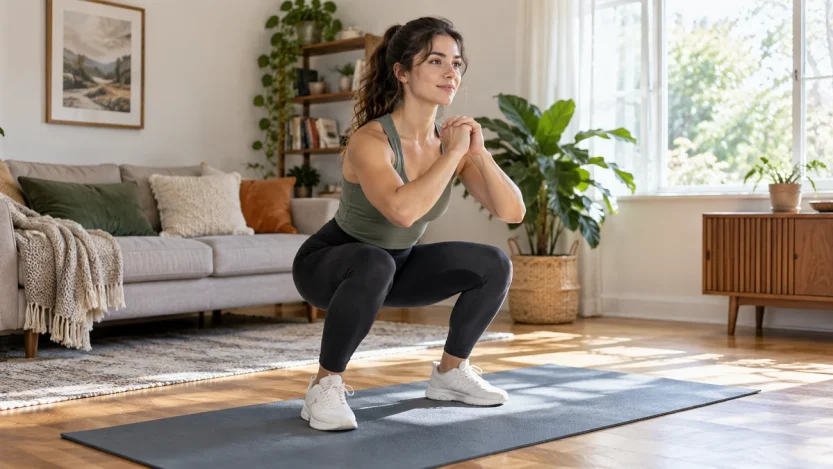
You do not need a gym membership, a rack of dumbbells, or a spare room full of machines to start moving. A home workout without equipment can still train your legs, hips, core, chest, shoulders, and arms. It can raise your heart rate. And it can fit into a living room, a hotel floor, or a few square feet of kitchen tile.
The short answer is yes: you can work out effectively at home using only your body weight. The session will not look like a commercial gym circuit. It does not have to. Bodyweight training is a practical way to build strength, improve general fitness, and meet public-health activity guidelines as long as you choose useful movements, keep the form honest, and get a little harder over time.
This is not a promise of a set amount of muscle or weight loss. Results depend on consistency, food, sleep, current fitness, and individual circumstances. What follows is a starting point you can actually use.
Can You Get a Good Workout Without Equipment?
Yes. A no-equipment workout can cover both of the activity types adults are generally advised to get: aerobic work (the kind that gets you breathing harder) and muscle-strengthening work.
The U.S. Department of Health and Human Services, summarized by the CDC, recommends that adults get at least 150 minutes of moderate-intensity aerobic activity a week, or 75 minutes of vigorous activity, plus muscle-strengthening work on two or more days. Those strengthening days do not require weights. Push-ups, sit-ups, and other bodyweight exercises count.
Bodyweight training works well for several parts of fitness. It can build strength across basic movements such as squats, hinges, lunges, pushes, and core exercises. Regular practice can also improve muscular endurance over time. Some bodyweight exercises, especially faster-paced movements, can raise your heart rate enough to provide a moderate or vigorous workout. Another benefit is flexibility: you can train in a small space and fit a session into a busy or changing schedule.
It cannot always replace very heavy loaded work such as barbell squats or deadlifts, or the precise load jumps some people use for advanced muscle-building. For most people who are starting out, coming back after a break, or training around a busy week, those limitations are not a reason to wait. A beginner home workout done twice a week will do more than an unused gym plan.
You can judge intensity with a talk test. During moderate work, you can talk but not sing. During vigorous work, you can say only a few words before pausing for breath. Jumping jacks, mountain climbers, and fast circuits often land in the vigorous range. Squats, lunges, and slower strength work usually sit closer to moderate, depending on how hard you push.
Best Exercises for a Home Workout Without Equipment
These eight movements cover the whole body. You do not need all of them in every session. Start with the ones you can do with control, then add others as balance and strength improve.
Clear a small space first. You need room to step backward into a lunge and to lie down fully. A yoga mat helps. A carpet or a folded towel works.
Squats
Squats train the legs and hips the muscles you use to stand up, climb stairs, and pick things up.
How to do them:
- Stand with feet about hip- to shoulder-width apart. Toes can point slightly out.
- Brace your midsection as if someone is about to tap your stomach.
- Sit the hips back and down. Keep the chest from collapsing.
- Lower until the thighs are about parallel to the floor, or as far as you can with control.
- Push through the whole foot to stand back up.
Beginner modification: Sit down to a sturdy chair and stand back up. Pause on the seat. This sit-to-stand is a real strength exercise, not a lesser version.
Common mistake: Knees caving inward, or heels lifting. Keep the knees tracking over the toes and the feet planted.
Lunges
Lunges train each leg on its own, which helps if one side is weaker. They also challenge balance.
How to do them:
- Stand tall, feet hip-width apart.
- Step one foot forward and lower the back knee toward the floor.
- Both knees bend. The front shin stays roughly vertical.
- Push through the front foot to return to standing, then switch legs.
Beginner modification: Hold a countertop or the back of a solid chair. Reverse lunges (step back instead of forward) are often easier to control.
Common mistake: A tiny step that sends the front knee far past the toes while the torso tips. Take a long enough step that the front knee stays over the mid-foot.
Push-ups
Push-ups work the chest, shoulders, and triceps, and they ask the core to stay rigid.
How to do them:
- Hands slightly wider than shoulder-width, under the chest.
- Keep a straight line from head to heels. Do not let the hips sag or pike up.
- Bend the elbows and lower the chest toward the floor.
- Press the floor away until the arms are straight.
Beginner modification: Start on a wall, then a kitchen counter, then the knees. Wall push-ups teach the plank-like body position before you add more load.
Common mistake: Elbows flaring straight out, or the head dropping. Keep the elbows at a comfortable angle, roughly 45 degrees from the body, and look at a spot on the floor just ahead of the hands.
Glute bridges
Glute bridges train the hips and the back of the legs without loading the spine the way a standing hinge might. They are useful if squats still feel awkward.
How to do them:
- Lie on your back, knees bent, feet flat and about hip-width apart.
- Arms rest by your sides.
- Squeeze the glutes and lift the hips until the body forms a line from shoulders to knees.
- Pause, then lower with control.
Beginner modification: Reduce the range. Lift only as high as you can without arching the lower back.
Common mistake: Pushing with the lower back instead of the hips. If you feel it mostly in the lumbar spine, lower the hips a little and think about tucking the pelvis slightly before you lift.
Planks
Planks train the core to resist movement, which is how the trunk actually works when you walk, carry bags, or do a push-up.
How to do them:
- Forearms on the floor, elbows under the shoulders.
- Extend the legs so the body is in a straight line.
- Squeeze the glutes and brace the abdomen.
- Breathe. Hold.
Beginner modification: Drop the knees, or hold a plank with hands on a countertop. Start with 10 to 20 seconds.
Common mistake: Hips sagging, or pushing them up into a pike. Check a side-on phone photo once or twice if you are unsure.
Mountain climbers
Mountain climbers combine core work with cardio. They raise the heart rate quickly, so they are useful in a short full-body home workout.
How to do them:
- Start in a high plank, hands under the shoulders.
- Drive one knee toward the chest.
- Switch legs in a running motion.
- Keep the hips as steady as you can.
Beginner modification: Slow the pace and step the feet instead of hopping them. You can also elevate the hands on a sturdy couch or bench.
Common mistake: Bouncing the hips up and down. Think of sliding the feet, not jumping.
Jumping jacks
Jumping jacks are simple cardio you can do in a small space. They count toward weekly aerobic minutes if they get you breathing harder.
How to do them:
- Stand with feet together, arms at your sides.
- Jump the feet out as the arms raise overhead.
- Jump back to the start.
Beginner modification: Step one foot out at a time and raise the arms, with no jump. Easier on the joints, and it still counts if you keep moving.
Common mistake: Landing stiff-legged. Soften the knees on each landing.
Bird dogs
Bird dogs train the back, glutes, and core with a lower demand than a long plank. They also help you practice moving the limbs without twisting the spine.
How to do them:
- Start on hands and knees. Hands under shoulders, knees under hips.
- Brace the midsection.
- Reach one arm forward and the opposite leg back.
- Pause without rotating the hips. Return, then switch sides.
Beginner modification: Move only the leg, or only the arm, until the hips stay still.
Common mistake: Arching the lower back, or lifting the leg so high that the pelvis tips. Keep the reach long, not high.
A Simple Beginner Home Workout Routine
This beginner home workout takes about 20 minutes. You do not need to be sore afterward for it to count. If you have not exercised in a while, stop each set while you still have a couple of good repetitions left.
Warm-up (3 minutes)
Move through these without rushing:
- March in place 45 seconds
- Arm circles, both directions 30 seconds
- Sit-to-stand from a chair, slow about 8 repetitions
- Hip hinges: hands on thighs, push hips back, stand up 8 repetitions
- Easy marching with a slightly higher knee 30 seconds
You should feel warmer, not exhausted.
Strength circuit (about 12–14 minutes)
Do 2 rounds. Rest 45–60 seconds between exercises if you need it, and about 90 seconds between rounds. Two seconds down, one second up is a reasonable tempo.
| Exercise | Beginner dose |
|---|---|
| Squats or sit-to-stands | 8–10 reps |
| Elevated or knee push-ups | 6–10 reps |
| Reverse lunges | 6 per leg |
| Glute bridges | 10 reps |
| Bird dogs | 6 per side |
| Forearm plank | 15–25 seconds |
Optional cardio finisher (2 minutes)
If you still feel steady: 20 seconds of stepping jacks or marching, 10 seconds of rest, four times. Skip this if you are already breathing hard from the circuit.
Cool-down (2–3 minutes)
Walk around the room until your breathing settles. Then hold each stretch for about 20 seconds, without bouncing:
- Standing calf stretch against a wall
- Gentle hamstring stretch
- Chest opener in a doorframe
- Child’s pose or seated fold, if your knees allow it
Drink water. That is the session.
How to Make a No-Equipment Workout Harder
Once the beginner dose feels comfortable you could do two more repetitions with good form make a small change. Do not change everything at once. Progression should be gradual.
- Add repetitions. Go from 8 squats to 10, then 12.
- Add a set. Two rounds become three.
- Slow the lowering phase. Take three seconds to sit into the squat or lower the push-up.
- Pause. Hold the bottom of a squat or the top of a glute bridge for two seconds.
- Shorten rest, but only if form stays clean.
- Move to a harder variation: chair squat to free squat, knee push-up to full push-up, static lunge to walking lunge, plank on knees to plank on toes.
Harder does not mean bouncing, rushing, or adding jumps before you can control the slow version. Jumping lunges and clap push-ups belong later, if they belong at all.
If a variation hurts a joint in a sharp or unusual way, go back to the easier version. Muscle effort is expected. Sharp pain is a stop sign.
How Often Should You Work Out at Home?
There is no single schedule that fits everyone. Age, job, sleep, stress, and current fitness all change the answer.
A realistic starting point for many beginners is two days a week of the strength circuit above, extra walking or easy cardio on other days even in 10-minute chunks and at least one full rest day.
That lines up with a common public-health pattern: muscle-strengthening on two or more days, plus enough aerobic activity to approach 150 moderate minutes a week. You can accumulate those minutes in short bouts. A 20-minute session counts. The older 10-minute-minimum rule is gone; smaller chunks still add up.
If you feel wiped out, unusually sore for several days, or you start dreading the workout, you are probably doing too much too soon. Keep the sessions. Reduce the volume.
If you already move a lot at work, you may need less extra cardio and more strength work. If you sit most of the day, even a short home fitness routine plus a walk is a meaningful change. Rest is part of the program. Muscles adapt between sessions, not only during them.
Common Mistakes to Avoid
Skipping the warm-up. Cold, stiff joints do not need a 15-minute ritual. They do need a few minutes of easier movement so the first squat is not the first thing you do.
Chasing a workout that looks impressive. Full push-ups with a sagging midsection are a worse choice than clean wall push-ups. The easier version, done well, is the better training.
Doing too much too soon. Soreness after a new routine is common. Being unable to walk down stairs for a week is a sign the first session was too large.
Ignoring recovery. Sleep, food, and rest days are not optional extras. They are how the work sticks.
Comparing your progress with other people. Someone who has been training for years will squat differently. That is not useful information for your first month.
Choosing exercises that are too difficult. If you cannot control the movement, it is not the right variation yet.
Working through warning signs. Stop if you feel chest pain, dizziness, unusual shortness of breath, or joint pain that is sharp rather than muscular. Contact a healthcare professional if those symptoms appear.
Safety Tips for Home Workouts
Most healthy adults can start light activity without special equipment. A few house rules still help.
- Clear the floor. Move chairs, toys, and cords out of the way.
- Use a stable surface for balance. Do not hold a rolling chair. A kitchen counter or a solid wall is better.
- Wear shoes if the floor is slippery, or if you are doing jumping jacks on a hard surface.
- Keep a phone nearby if you train alone.
- Start at a level that feels almost too easy for the first session. You can add work next time.
- Breathe. Do not hold your breath during strength work.
- Stop a movement if something feels wrong. Substitute another exercise from the list.
If you have an injury, a medical condition, are pregnant, recently gave birth, or have been advised to limit exercise, speak with a doctor or other appropriate healthcare professional before starting or changing a routine. This article is general fitness information, not medical advice or treatment.
Frequently Asked Questions
Is a 20-minute home workout enough?
It can be. Twenty minutes of focused bodyweight work can train strength and raise your heart rate. Over a week, several short sessions add up toward recommended activity levels. A longer workout is not automatically better if it causes you to skip days.
Can bodyweight exercises build strength?
Yes. Strength improves when a movement is challenging enough that the last few repetitions are hard, and when you gradually make the work harder. Beginners often gain strength quickly with bodyweight exercises. Later, you may need harder variations to keep progressing.
Can home workouts help with general fitness?
Yes. A mix of bodyweight strength work and cardio movements marching, stepping jacks, brisk walking supports general fitness: stronger muscles, better endurance, and more capacity for daily tasks. Food, sleep, and how much you sit the rest of the day still matter.
How many days per week should a beginner exercise?
Two to three days of structured work is a reasonable start, with walks on other days if you can. Public-health guidance notes that some activity is better than none, and that weekly minutes can be spread out rather than done in one long session.
Do I need a yoga mat?
No. A mat is more comfortable for floor work. Carpet, a towel, or a rug can substitute. Avoid slick floors for standing exercises, and wear shoes if the surface is slippery.
What if I can only do a few push-ups?
Use an easier angle. Wall or counter push-ups let you accumulate quality repetitions. That is more useful than grinding out two messy floor push-ups and then quitting the movement.
Should I exercise if I am sore?
Mild muscle soreness is common after new work. Light walking or an easier session is often fine. Skip or reduce the workout if soreness is severe, or if a joint hurts in a sharp way rather than a tired-muscle way.
How long should a home workout last?
Long enough to do the work with decent form, and short enough that you will repeat it. For a beginner, 15 to 25 minutes of strength work plus a brief warm-up is plenty. Cardio minutes can live in the same session or in a separate walk.
Start With the Floor You Have
You already have what a beginner home workout requires: the floor, a little space, and enough time for a short session. Pick a few of the exercises above, run the 20-minute routine twice this week, and keep the form honest. When it feels easy, add a repetition or a harder variation not a whole new program.
The useful next step is not a perfect plan. It is the first round of squats, done today or tomorrow, in the space you already have.