
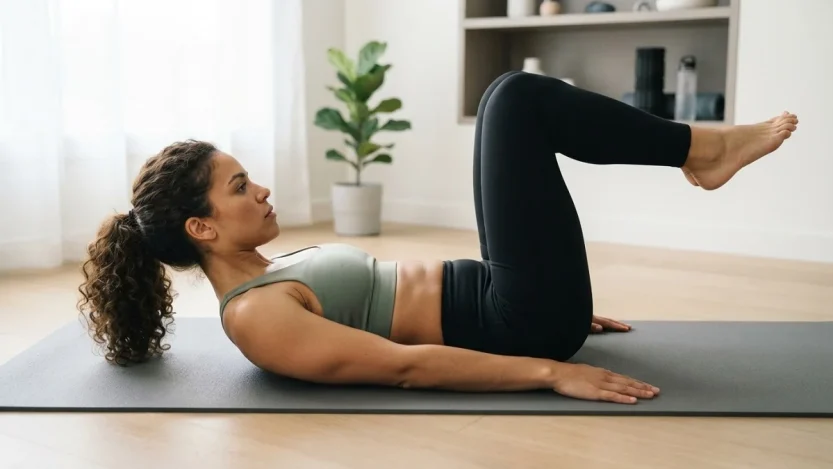
Reverse crunches are a physical exercise that is done to strengthen the abdominal muscles. In which the hips and waist are pressed upwards with control. In normal crunches, you lift your shoulders and upper body. You bring your knees and hips closer to your body and keep your upper back on the ground.
This exercise can also be done at home without any equipment. However, the right approach is very important for its accurate results. The aim is not to throw the legs up jerkily but to use the abdominal muscles with control to compress the shin towards the torso.
What Is a Reverse Crunch?
Reverse Crunch is an exercise that is performed by lying on your back. Initially the knees are bent and the feet are above the ground. The sherwani is then slowly squeezed upwards. So that the lower part of the body moves towards the chest.
In this exercise there is no need to lift the whole back from the ground. Movement should be limited and controlled. Trying to get up too high often distorts the original style of exercise.
During this movement, the sage’s change in position is very important. The action works better if you keep your back straight and your abdominal muscles strong while you work out.
Which Muscles Does a Reverse Crunch Work?
In the reverse crunches, most of the work is done by the large muscles of the front part of the abdomen. These muscles help in flexing the torso and keeping the stomach strong.
The oblique muscles on both sides of the abdomen also participate in this movement. These muscles help to control the position of the torso and pelvis.
The muscles that flex the hips also work in this exercise, as the legs remain elevated in the bent position. However, the burden of the entire movement should not fall on these muscles. If the legs start to move with a jerk, the muscles of the hips may start to work more than the muscles of the stomach.
It should also be noted that there is no separate muscle in the lower abdomen. The same large muscle in the front of the abdomen may be felt more in its different parts during different movements, but they are not separate muscles.
How to Do a Reverse Crunch
Follow these steps to do the reverse:
- Lie on your back on a mat for exercise.
- Bend the knees and lift them up so that the lower legs are almost parallel to the ground.
- Keep the arms beside the body or place the hands in a place where they can provide only minor support.
- Strengthen the abdominal muscles and allow the upper back to rest against the mat.
- Slowly lower your hips upwards and bring your knees towards your chest.
- Lift the hips as high as you can with control without jerking the legs.
- Take a short pause at the top.
- Slowly bring the hips back to the initial position.
Instead of just bringing the knees to the chest during this move, pay attention to how the shin contracts. The movement of the knees will be visible, but the main part of the exercise is the upward turn of the hips and groin with control.
Proper Reverse Crunch Form
The correct technique of reverse crunching has a big impact on how the exercise makes you feel.
Keep the movement slow enough that you can feel the work of the abdominal muscles. The hips should come up because you’re contracting the shin, not because you’re jerking the legs.
Avoid putting too much pressure on your hands. The hands are just to give a little support to the body. Lessen the range of motion and work on the abs if you have to push on the ground with your hands to lift your hips up.
Correct breathing can also be helpful. Exhale while contracting upwards and inhale while coming back to the initial position. There is no need to hold your breath throughout the exercise.
Keep your head and shoulders relaxed. The reverse crunch does not require the upper body to be lifted up like a normal crunch.
Common Reverse Crunch Mistakes
Some common mistakes can make reverse crunching less effective and less controllable.
Swinging the Legs
Swinging the legs around quickly can change the way the exercise is done by bringing the knees closer to the chest. In the beginning, do fewer reps and work on moving smoothly.
Lifting the Hips Too High
It’s not important to lift the whole hip or wrap your body around your back. Only lift the pelvis so that the abdominal muscles can work right.
Moving Too Quickly
Moving too fast makes it difficult to control the body in both up and down directions. Exercising at a relatively slow pace makes it easier to keep the motion correct.
Pulling With the Arms
Hands should only be used for balance and support. If you are lifting the hips with the arms outstretched, facilitate the movement and perform in a low circle.
Letting the Lower Back Arch Excessively
Bending the lower back too much can make it difficult to control the initial condition. Adopt a position in which the stomach and pelvis remain stable and movement can be relaxed.
Reverse Crunch vs. Regular Crunch
Both exercises are used to strengthen the abdominal muscles, but they have a different movement style.
In normal crunches, the upper torso is raised towards the shin. The shoulders and upper back remain on the ground in the reverse crunch. While Shruni shrinks towards the torso.
The same difference causes some people to find reverse crunches more comfortable, especially when they like to keep the head and upper back on the ground.
Still, these two workouts aren’t for everyone. When you work out, how often, how comfortable you are, and your technique all play a role.
Reverse Crunch vs. Leg Raise
Reverse crunches and leg raises may look similar, as both involve the legs being up, but the basic movement is not the same in both.
In leg lifting exercise, the legs are moved up and down in a relatively large circle. While the core is more stable. The main movement in the reverse crank is when When it reaches the top, the sherwani is squeezed towards the torso.
This difference needs to be understood. If you’re just moving the legs up and down and not squeezing the shin upwards, the motion is more close to a leg-raising exercise rather than a reverse crunch.
How Many Reverse Crunches Should You Do?
This is a question that different people will answer differently. It is contingent upon how often you exercise, how long you can hold proper form and how experienced you are.
A good place to start for general fitness can be two to three sets of eight to fifteen controlled repetitions each. You don’t need to follow this rule, but it’s a good starting point.
Quality of exercise is more important than quantity. When the technique starts to deteriorate, it may be better to take a break rather than do more repetitions.
Take as much rest as you need between each set. As the exercise becomes easier, the repetition can be increased appropriately or a slightly harder approach can be taken, but it is not necessary to increase the speed.
How to Make Reverse Crunches Easier
If you are just starting out, there is no need to make a full and difficult move on the first day.
Start with a small circle. First practice bringing the knees in the correct position and slightly contracting the shin, while keeping the legs from swinging.
Exercise can also be done with less repetition, especially when you want to focus on movement. It is more appropriate to correct the pattern first and then increase the quantity.
If you find it difficult to keep the legs up, improve control of the central part of the body through some simple basic exercises and then move on to more difficult movements.
How to Make the Reverse Crunch Harder
When the normal reverse crunching starts to feel easy, the difficulty can be increased without spoiling the technique.
One way is to slow down the movement while coming down. The second way is to gradually increase the number of repetitions while maintaining the correct posture.
The position of the legs can be changed in a more difficult way or appropriate resistance can be added. Difficult moves, however, are not always better. If the increased difficulty of the exercise causes the body to lose control, the legs to swing, or the back to bend too much, then the basic reverse crunch could be a better option.
Can Reverse Crunches Help Build Stronger Abs?
To build stronger abs, add reverse crunches to your exercise regimen. However, one exercise is not enough to define the overall central strength or the appearance of the body.
It is useful to include a variety of movements for better training of the core. Exercises that work on flexing the torso, keeping it straight, resistance to rotation and physical stability can be included.
The amount of fat in the body is also affected by many factors such as diet, overall physical activity and energy balance. Therefore, the fat of any one part of the stomach cannot be specifically reduced by doing more reverse crunches.
Is the Reverse Crunch Good for Beginners?
Yes, with proper circumference and controlled movement, this exercise can be suitable for beginners as well.
The real difficulty is to get used to shrinking the sherwani instead of swinging the legs. Exercise slowly in the beginning and stop the repetition when the movement is not maintained.
You might also find it helpful to get direct help from a real fitness expert if you’re having trouble understanding the technique.
Safety Tips for the Reverse Crunch Exercise
The reverse crunch should be a controlled exercise for the abs, not one that hurts.
Stop exercising if you feel sudden or unusual pain in the lower back, hip, or neck. General muscle fatigue and pain that involves chewing or sudden discomfort are not the same thing.
Prior to starting a new exercise routine, people who have had an injury, a serious back problem, or any other medical issue should think about getting advice from a medical professional.
Use a strong and slippery place for exercise and keep enough space so that the movement can be done comfortably. There is no need for heavy equipment for this exercise.
How to Add Reverse Crunches to a Workout
Reverse crunches can also be part of a short home workout routine and can also be incorporated into full strength training.
For a simple core workout, it can be done with another exercise for the abs and a move that requires the torso to be stabilized in a different way.
Making sure it fits in with your daily schedule is the most important thing. You can work out before or after this.
Start with enough to maintain the correct technique. Repetition may be increased or a relatively harder style may be added as control improves over time.
Final Takeaway
Reverse Crunch is a physical exercise in which the spine is compressed towards the torso while keeping the upper back on the ground. In this, the muscles of the front part of the abdomen work mainly, while the muscles of the sides of the abdomen and the muscles that bend the hips also take part in the movement.
In this exercise, the correct and controlled technique is more important than doing too many repetitions quickly. Avoid jerking the legs and exercise in as many circles as you can comfortably control.
For general fitness, reverse crunches can be a useful part of a balanced routine consisting of various core exercises.